Sunday, August 24, 2014
Aegean Hawks Documentary Teaser
This post is a bit different than what you are used to reading. I usually ask you to read a long history of a club, person, or event in US soccer history. Today, I ask that you take the time to appreciate the game at all levels. From amateur to the top flight, the game has a way of capturing our attention.
Above is a teaser/trailer of a documentary that my friend Justin Feltman and I have been working on for the last few months. After covering a 2015 Lamar Hunt US Open Cup game in April of this year, Justin and I decided to take a closer look at the amateur game in Washington DC, and latched onto Aegean Hawks FC.
The people involved with the club allowed us to follow them around during their short run at qualifying for the 2015 US Open Cup and their subsequent championship Washington Premier League Spring Season.
In the coming months, we will be looking to release a short documentary on the history of the club and their ambitions for the future. Until then, please check out the teaser/trailer and give us your opinion.

Thursday, July 31, 2014
Liverpool's 1946 American Odyssey
This story originally appeared on 8by8mag.com
 |
| Source: LiverpoolFC.com |
In 1946, Liverpool F.C. came to the United States for “American malts and ice creams” and a few games of football, too, in the club’s first European preseason tour of the United States.
The expedition was the brainchild of Liverpool chairman William H. “Bill” McConnell. As the proprietor of a catering business, McConnell visited the United States for the British Ministry of Food in 1945 and noticed that America’s food industry emerged from World War II unscathed. To take advantage of the American food bounty and to get a leg up on their underfed English competition, McConnell proposed that Liverpool tour the United States in the summer of 1946 prior to the start of the first full season since the beginning of World War II.
America’s dietary prosperity stood in stark contrast to England’s austere food rationing program. Following the war, goods such as coffee and processed meat were increasingly scarce, as the British government had to not only feed their own citizens but also feed people within British occupied zones abroad. England was even forced to ration bread in 1946, which it had not done at all during World War II.
After a nearly week at sea aboard the RMS Queen Mary, twenty-two members of Liverpool docked in New York on May 10, 1946. Moments after arrival, Liverpool manager George Kay stood on the dock, surrounded by delegates of the American Soccer League (ASL) and gleefully checked off the names of each Liverpool player as they came down the gangplank. Photographers gathered at the waterfront while Kay pandered to the throng, brandishing the 1923 FA Cup Medal that he won as a member of West Ham United.
Liverpool’s ten game jaunt garnered significant attention from the American and English press. A number of newspapers, including The Brooklyn Eagle, The New York Times, and The Liverpool Echo documented every detail of Liverpool’s American summer vacation. Kay also kept the fans back in Liverpool informed about the Reds’ exploits by sending letters to The Echovia airmail throughout the tour.
The media’s plaudits proved well placed as Liverpool won their first game 3-1 over a team of ASL players at Triborough Stadium on Randall’s Island. The match drew around 20,000 spectators, nearly 5,000 more the Brooklyn Dodgers drew at Ebbets Field the same day. Dodger’s owner Branch Rickey took note. He would be instrumental in hosting Liverpool in the first game between two international clubs on American soil in 1948.
After three consecutive wins over American clubs, Kay gushed, “The terrific hospitality we are receiving is the only thing likely to beat us,” in The Echo. “You can get all of the dishes everybody could possibly desire…naturally we’re taking advantage.”
But while Liverpool’s players were stuffing their waistlines, the Reds were being sized up by the New England All-Stars, one of the best American elevens. The All-Stars featured many players from the 1947 U.S. Open Cup Champions Ponta Delgada, a club in Fall River, Massachusetts, an early hotbed of American football.
The game, postponed a day due to heavy rain, kicked off under floodlights in front of a sold out crowd of 7,000. Initially, the New Englanders were overwhelmed but held firm against the visiting English. The locals then settled into the match, pressing the Reds, and Joe Chapiga, a New England striker, rifled a shot against the upright midway through the first half in proper Minuteman fashion.
The Reds eventually found their footing in the 44th minute, according to the Boston Globe, as Jack Balmer “outwitted the New England defense, and with a dynamite drive, opened the scoring.” In the second half, the Reds came out blitzing the New England defense, and Liverpool star Robert Priday put the visitors up 3-0 in a matter of minutes.
Undeterred and out to prove that they could compete, the New England All-Star eleven pressed the Liverpool defense, and Chapiga proved his worth, scoring what The Globe called, “an electrifying goal” past Liverpool’s keeper Cyril Sidlow.
The All-Stars constantly attacked the Reds thereafter, having a potential second goal called back due to a handball. Ed Souza, a member of the 1950 United States team that would defeat England in the World Cup, sent the crowd into a frenzy after scoring a legitimate second goal late in the match.
But the Reds weathered the Yankee onslaught and left Massachusetts with a 3-2 victory. After the game, Kay mentioned his dissatisfaction with the prolonged celebrations of the New England men following their goals, relying on tired American stereotypes: “Joe and Ed flung their arms around each other, waited in the center circle, and it needed only a banjo to make it a real hill-billy show. The other players of their side gave individual step dances in their joy.” Just as football tours have a long history, so too does English condescension towards the American interpretation of the game.
Despite Kay’s irritation, the Reds compiled a perfect 10-0 record on their American tour and amassed a goal differential of plus sixty while enjoying copious helpings of American cuisine. The tour was so successful in its initial aim that each player gained an average of seven pounds during the six-week long journey. Returning to England, the American preseason endeavor helped Liverpool persevere through one of the longest campaigns in league history and capture their fifth league crown in June 1947.
As Liverpool participate in this year’s Guinness International Champions Cup, it is important to recognize the role that the Reds tour in 1946 had in shaping modern football tours of the United States. Although Liverpool didn’t intend to start a trend in 1946, the tour’s financial success encouraged promoters on both sides of the Atlantic to continually schedule tours throughout the second half of the twentieth century, highlighting the growing football culture in the United States and allowing fans to see their their favorite clubs and players in person. These forays can be seen as world football’s take on an all-star game: the best players taking center stage for the fan’s entertainment.
So as you enjoy the abundance of football available this summer in the United States, remember to watch the matches like Liverpool did: with a full stomach.
Don't forget to check out the fine work over at www.8by8mag.com Also, check out the subscriptions available for their print magazine.

A very special thanks to @TheSpiritof1892 and @SteHortonLpool for their assistance in finding English sources for this article. Also, thank you for editors at 8by8 for accepting this piece, and working with me on fine tuning it. In writing this article, I perused a number of sources. As always, I am indebted to the American Soccer History Archives for their abundance of available information. I used several newspapers as my primary source material specifically, The Brooklyn Eagle, The New York Times, and The Liverpool Echo.
If there is any interest in further details surrounding Liverpool's groundbreaking tour, let me know and I will work on writing another article.
Saturday, June 14, 2014
World Cup Hopeful Team America and the Case for RFK: Part Two
You can read the first part of this article HERE.
A
Faulty Foundation
As the players prepared for their preseason tour,
Team America’s brass hurriedly constructed a marketing plan with a publicly
stated budget of $300,000 to $400,000. The team’s front office recognized that
not only were they were selling Washington, D.C. area fans their third team in
four years, but they were also attempting to sell an “all-American” team to an
apathetic and uninitiated audience. Therefore, the club’s leaders relied on the
team’s status as the USMNT, its alleged national appeal, and individual player
personalities to draw people to RFK Stadium. In addition to its ambitious
marketing plan, Team America’s front office was able to secure the patronage of
R.J. Reynolds as its primary sponsor. The tobacco company bestowed a publicly specified
sum of $2.5 million on Team America, while Budweiser chipped in around $200,000
to $250,000 to the USSF backed effort.
 |
| Source: The Washington Post |
With its significant marketing budget and corporate
sponsors in the fold, the marketing team of Team America committed to the
timeless NASL practices of participating in international friendlies, heavily
promoting their home games against the New York Cosmos, and coupling one of the
club’s games with an after game concert. The club secured the services of the
Beach Boys for their June 12 match up against the Ft. Lauderdale Strikers, which
garnered national attention during the preseason after James Watt, the acting
Secretary of the Interior, banned the Beach Boys, and “rock music,” from the
city’s Fourth of July celebration on the National Mall. The ban, issued after
Team America scheduled their concert, left many people outraged including Vice
President George H.W. Bush, who backed the band stating, “They’re my friends
and I like their music.” The ban proved a boon for Team America as it generated
considerable nationwide interest in the event, but in the end, it underscored
the club’s biggest problem; the investors and front office’s focus on the
financial profitability of the project and its role in saving the NASL, and not
in securing the team the best “American” talent. The problem would plague Team
America throughout the season.
As much positive press as Team America were able to
generate prior to their Caribbean and South American tour, Panagoulias only had
thirteen players at his disposal headed into the international expedition. Most
of the players on the Team America roster were what many would quantify as a
typical American player: athletic and strong, but lacking in technical ability
and on-field ingenuity. The lone capable forward on the roster, Tony
Crescitelli, was anything but lethal having failed to score in twenty games
with the San Jose Earthquakes during the 1982 season. Panagoulias knew he would
need players with greater offensive prowess in order for the team to compete in
the long term.
The USMNT manager once again attempted to court
Ricky Davis and a slew of other prominent American players, including Mark
Peterson and Jeff Stock of the Seattle Sounders, only for America’s most
talented players to spurn him again. Peterson was arguably the best American
forward at the time and could have added a considerable threat to Team
America’s already anemic attack.
Several players including US International Boris
Bandov did join Team America for the tour, but the refusal of the country’s top
players to accept a national team call-up baffled and infuriated Panagoulias. Stock’s
and Peterson’s eschewal particularly enraged Panagoulias leading to the Greece
native to lash out declaring,
“I am furious about the Seattle team and their
players. They told me Peterson and Stock did not want to come because they
wanted to play in games against some colleges next week. This is absolutely
ridiculous. We’re talking about the national team here. What the heck is going
on in this country?”
In spite of the steady lack of interest and support,
Panagoulias and Team America carried on with the talent already on the roster.
The makeup of the team left Panagoulias little choice but to play defensively,
which in theory was in direct opposition to Team America’s goal of spurring
interest in America soccer and the NASL. Up to that point in its history, the
NASL instituted a number of distinctive rules to make soccer more appealing to
the American fan; i.e. a greater emphasis on offense and goals. From the penalty-shootout
to the thirty-five yard line offside rule, the NASL had always promoted an
offensive, high scoring game. Now Team America stood as the antithesis to what
the league had always promoted. The best offensive American players continued
rejections forced Team America, the anointed savior of the NASL, into adopting
a defensive approach heading into the 1983 NASL campaign. The style would prove
to be initially effective but wildly unpopular, and contribute to the club’s
downfall.
International
and League Surprise
 |
| A fully stocked Team America outside the entrance of RFK Stadium Source: http://www.nasljerseys.com/images |
Still reeling from their collective slight,
Panagoulias and Team America started their preseason tour in the Haitian
capital with a 1-0 victory over a Port-au-Prince select team on April 6, 1983.
Two days later, Team America competed in their first, and only, FIFA sanctioned
international fixture against the Haitian National Team defeating the island
nation 2-0 with the two goals coming from Jeff Durgan and Chico Borja. Team
America followed up their set of Haitian victories with a pair of losses to
greater competition from Colombian clubs Coruna Cristal and Deportivo Cali. In
their two games in South America, the USMNT conceded five goals and scored via
a lone penalty emphasizing the team’s weakness at forward. Overall,
Panagoulias’ men fared well having scored four goals while only conceding five,
but the team’s lack of a playmaker and goal scorer would prove lethal for the
team by seasons end.
Following Team America’s overseas sojourn, the team
returned to Washington a week before their NASL debut with just twelve players under
contract. With barely enough players to take the field, the team cancelled
their final preseason game against the University of Virginia in order to prevent
losing players to injury. It did not help that the club’s facilities were of
little help in promoting the player’s health.
The USMNT’s accommodations at the unofficial
national stadium, RFK, were perhaps fitting for the maligned team with the
sparse roster. According to The
Washington Post, the team’s place within the Washington sports world was more
appropriate for “Team Podunk,” and not the USMNT as the team’s locker room was
comprised of outdated furnishings in the bowels on the stadium.
 |
| Source: http://www.nasljerseys.com |
Despite the consistent negativity surrounding the
club, the players who had signed with Team America, led by Captain America Jeff
Durgan, were bullish about the upcoming season and the importance of Team
America to the survival of the game in the United States. All that was needed
were a few more players to fill out the roster. The league soon stepped in and
fulfilled that need loaning Boris Bandov, the US active leader in caps at the
time, and Alan Green to the national team on a game-by-game basis just one day
before the season opener. (Both would later sign permanently.) The continual derision
led Jeff Durgan to lament the amount of support the team received up to that
point. The USMNT captain elicited help from all American players who wanted to
continue playing the game professionally in America stating,
“If you’re American and want to play professional
soccer in this country, then you should be playing for Team America, because if
it doesn’t make it, the league might not make it.”
Durgan’s sobering
statement once again emphasized not only the haste in which Team America was
created, but the lack of cohesion amongst the different entities involved: the
NASL owners, the MISL owners, the USSF, and individual American players. In
addition to the ongoing issues surrounding the team, many people, principally
the NASL Players Association, openly questioned the amount of naturalized
citizens on the roster bemoaning the true intentions of the so called “Team
America.” Under these tumultuous circumstances, Panagoulias led Team America
into their first domestic campaign praising the team stating, “Right now we
look like the 300 Spartans against the Persians, but I have faith in these
boys.”
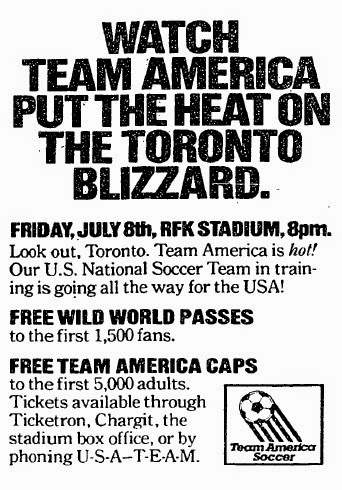 |
| Washington Post Ad for Team America's game against the Toronto Blizzard on June 7 Note the ad's reference of Team America as the USMNT Source: The Washington Post |
Team America opened the 1983 NASL campaign with
shootout victory over the Seattle Sounders. (The league did not permit draws
and every game had a definitive victor and loser with penalty shootouts
deciding stalemates after extra time.) The victory may have come as a surprise
to some, but the way the national team won the game was what many people expected,
as Team America did not force Seattle goalkeeper into a save until late in the
second period of overtime. Despite the win, coverage of Team America the
following day centered on the team’s offensive futility, but Panagoulias would
have none of it. The former Olympiakos manager extolled the beauty of a
defensive style of play while questioning American’s obsession with offensive
and tactically unsound soccer.
Following their victory against Seattle, the team
faced a both a daunting schedule during the month of May and the scorn of the
MISL who refused to release players to the USMNT. The MISL’s insolence prompted
Howard Samuels to declare, “The MISL is holding Team America hostage.” After
notching a 1-0 win in their home opener at RFK Stadium against the Tulsa
Roughnecks on May 8, the team crisscrossed the Western Hemisphere competing in
six games in twelve days from May 15 to May 27. The team’s schedule included
two international friendlies, one against English side Watford in Kingston,
Jamaica, and the other against the Soviet champions, from Belarus, Dynamo Minsk
in St. Louis, Missouri. The two friendlies once again served as an arena for
Samuel’s and the proponents of Team America to prove their intentions to
construct and field a competent and competitive national side, though the
project’s detractors would continue to vehemently voice their displeasure
regardless of Team America’s satisfactory domestic and international
performances.
 |
| Team America with President Reagan |
Overall, Panagoulias’ men finished the month of May
with a respectable overall league record of three wins and three losses, but
the team continued to struggle offensively. In these matches, Team America
competed amid player snubs, the MISL’s refusal to cooperate with the NASL and USSF,
an apathetic fan base, and mounting public scrutiny. Players, pundits, and fans
alike were not buying into the Team America scheme, lending future doubt on the
sustainability of the entire concept. LA Times columnist Grahame L. Jones
denounced Team America as sham asserting, “It was idea doomed to failure from
the beginning.” Jones lamenting the amount of naturalized Americans on the
roster added, “It [having naturalized American’s on the roster] somehow goes
against the very purpose of the concept,” prior to the USMNT’s game against the
San Diego Sockers. Jones would not be the last member of the media to lambast
Team America, but by the time of his article, even Panagoulias, long the
champion of the national team cause, publicly began to doubt the viability of
the project humbly stating, “We’re trying to have a strong national team, and I
don’t know if were succeeding,”
Nevertheless, Team America continued to develop as a
team, signing several more players, including MISL midfielder Tony Bellinger,
who defied the MISL’s ban on lending players to Team America due to a clause in
his contract with the indoor league allowing him to play outdoors. Bellinger, seeing
the progress that Team America had made since its inception, was the first of several
Americans who joined the team after first refusing a call up, though he may
have been tempted to sign due to Team America’s lucrative incentive plan that
gave players a profit-sharing agreement with the team’s owners. The plan, which
later became public knowledge, offered players a stake in the team in addition
to bonuses for appearances and man-of-the-match (MOTM) awards, which, at
seasons end would net the player with the most MOTM awards an extra $10,000.
The incentive plan was a last ditch effort by Robert Lifton and Samuels to lure
America’s top players to the squad.
 |
| The Beach Boys playing at RFK following Team America's victory over the Strikers Photo Credit: AP Photos Photographer: Ira Schwarz |
The team’s inability to score goals and defensive
tactics understandably failed to resonate with Washington’s fans as the team
were barely drawing 11,000 people to RFK at that point, though the team’s
coupling of the Beach Boys concert with their game against the Strikers did
coax 50,000 fans to the stadium. The team’s defensive mentality, combined with
the amount of naturalized American’s on the roster, led Washington Post columnist Ken Denlinger to call the team “Unamerican,”
while adding, “More goals would certainly attract more fans,” despite Panagoulias
temporarily guiding the team to first place in the NASL’s Southern Division in
early June. Team America’s goalkeeper, the naturalized Englishman Paul Hammond
referring to Team America’s lack of offensive prowess, said it best, “If you
look at things logically, there has to be a breakdown sooner or later.”
Inevitable
Decline
Despite rattling off four consecutive of wins to
start the month of June, including a 2-1 shootout victory over the New York
Cosmos on June 17, Team America’s lack of offensive prowess fed the growing negative
sentiments concerning the “un-American” tactics on display at RFK. Ken Denlinger,
a season long antagonist, again pointed out just how ineffective Team America’s
offensive was by highlighting their inability to score in the second half of
games leading the columnist to label the club “Team Tranquilizer.” Denlinger also
continued his nativist diatribe as the season wore on referring to the club as
“Team Immigration.” It was amid this constant criticism and continued offensive
feebleness that Team America’s lack of a creative goal scorer proved to be the
team’s Achilles heal with the USMNT dropping four of their next five games getting
outscored 10-3 in the process. The losing streak brought the team’s record to eight
wins and seven losses halfway through the season. The second half of the season
would prove just as tough for Panagoulias and the USMNT even after long awaited
reinforcements arrived.
As Team
America continued to lose, interest in the team, already tenuous, began to wane
considerably alongside any resemblance of positive press regardless of how much
Panagoulias wanted to exaggerate interest in the team. The Team America venture
reached critical mass near the end of July after the team dropped its eighth game
in a row bringing their record to eight wins and twelve losses leaving them in
last place in the Southern Division. Attendances at RFK were dwindling rapidly
with every loss. The team drew Team America drew a paltry 5,281 fans to the
stadium against the Montreal Manic on July 31. The losing streak and lack of
fans led owner Lifton to threaten to withdraw Team America from the league
stating,
“The attendance is a product of the team’s playing,
and the team’s playing is the product of the fact that the NASL did not do what
it said it was going to do, which was give us the best American players, and
the MISL did not do what they said they were going to do, which was fill in
with more players.”
During the prolonged losing streak, perhaps because
of Lifton’s outburst, Samuels ordered the NASL owners send American players on
loan to Team America to turn the USMNT season around, and effectually save the
league. Panagoulias, after speaking with Lifton and Samuels, agreed to allow
players to join the team on loan as long as he could choose the players. He still
coveted Seattle’s Mark Peterson but the forward’s eventual permanent move could
not save the floundering project.
 |
| Mark Peterson competing for a header against the Chicago Sting Source: http://www.nasljerseys.com Photo Credit: Chicago Tribune |
In the end, Team America dropped fourteen of their
last sixteen games finishing the season with the league’s worst record with ten
wins and twenty losses. The lone bright spot of Team America’s slide was the
team’s 1-1 draw against Italian giant Juventus, a club that fielded seven
players from Italy’s 1982 World Cup winning squad. Lifton’s threats to withdraw
his support from the venture grew as the season wound to a close culminating in
a series of demands from Team America’s owner including Panagoulias' right to
choose the players he wanted for the team. The businessman, claiming losses of
over one million dollars, found little sympathy for the league’s other owners
who were losing far more money supporting their clubs. By seasons end, both the
Montreal Manic and the Seattle Sounders would cease to exist after each club’s
owners could no longer afford to keep the teams afloat.
Team America’s players also balked at Lifton’s plan
refusing to return to the clubs they played for prior to joining the USMNT
fearing that they would find themselves unemployed due to their commitment to
the moribund project. Despite the player’s demands to stay in Washington and
the Team America’s ongoing negotiations with the USSF and NASL, Team America’s
Lifton released Team America’s players to their parent clubs after Lifton, the
USSF, and the NASL could not come to an agreement surrounding the future of the
team.
Even as Lifton and the supporters of Team America
still clung to the minute chance of fielding a team in 1984, the concept, and
the league, was crumbling. RFK Stadium official’s confiscation of Team
America’s equipment and closure of the team’s locker room in early October signaled
the end of the of the shortsighted project after Lifton refused to pay the
stadium’s rental fees. Ultimately, Team America was a failure. Samuels’ proposal,
hampered throughout its existence, did not achieve any of its stated goals during
its short existence in the NASL.
 |
| A Captial Idea? Source: http://www.funwhileitlasted.net |
Though Team America did not exist in the NASL after the
1983 season, Panagoulias continued to manage the USMNT through the qualifying
matches for the 1986 World Cup providing a sense of hope that Team America,
despite its NASL’s shortcomings, would achieve its ultimate goal of qualifying
for the world’s most prestigious sports tournament.
As always, I relied on a number of sources, both primary and secondary, in writing this article. I perused many newspapers with The Washington Post being chief among them. I also consulted The Chicago Tribune and The New York Times. In addition to these dailies, I gleaned information from several online sources including; http://www.nasljerseys.com, http://www.funwhileitlasted.net/, among others. As always, I would be lost if it weren't for the American Soccer History Archives.
Sunday, June 8, 2014
World Cup Hopeful Team America and the Case for RFK: Part One
A number of journalists
and writers have penned articles about Team America and the team's place within
American soccer history. With this
article, I intend to shine more light on the problems that plagued Team America
from its inception, but I also attempt to highlight the positives of the doomed
team's existence and its greater place within the history of American soccer,
and America's unofficial national stadium, Robert F. Kennedy Stadium.
Note: For the purposes
of this article, and brevity, one can assume that Team America and United States Men's
National Team carry the same connotation throughout the article. I use the two
terms interchangeably.
Having participated in every World Cup since 1990,
merely qualifying for the tournament is no longer a novelty for the United
States. Every four years, American’s expect the US Men’s National Team (USMNT)
to not only qualify for the world’s greatest sporting event, but also believe
the team can make a deep run in the tournament as they did in 2002.
Expectations for the US, prior to the World Cup draw in December 2013, were
arguably the highest they have ever been in American soccer history. This, of
course, was not always the case, as the US experienced a forty-year period of
futility between their legendary victory over England in 1950 to their three-and-out
appearance in Italy.
That is not to say that there was not a genuine
effort by the USMNT to qualify for the World Cup in the intervening years. Prior
to participating in the 1990 World Cup, the US would always fall short of
qualification, which was often the result of negligence from the sport’s
governing body in America, the United States Soccer Federation (USSF). The
governing body often left national team managers with little resources and just
days to assemble a competent squad prior to international fixtures. That is
assuming that the USSF were even able to convince North American Soccer League
(NASL) clubs to release their players for international duty in the first place.
Attitudes began to change in the early 1980s. The NASL was hemorrhaging money
year after year, and the brass within the USSF began to realize the importance
of the World Cup and the revenue it could generate. The sudden interest crystalized
during the winter of 1982-3 culminating in the formation of Team America, and
led to the first legitimate use of Robert F. Kennedy (RFK) Stadium as the USMNT
home ground making it the unofficial national stadium.
 |
| http://www.sportslogos.net |
Team
America; A Questionable Concept
Team America was the brainchild of NASL President
and CEO Howard Samuels. He presented the concept of the USMNT competing
as a franchise (Team America) in the floundering NASL at the league’s annual
meeting in late October 1982. The impetus behind the plan was three-fold: to ramp up the Americanization of
the game and develop a national team that could qualify for the 1986 World Cup,
to develop a national team that could potentially compete in the 1984 Olympics
in Los Angeles, and, most importantly, to generate interest and revenue for the
NASL. The idea even had the support of the USSF, which given the history of
relations between the two entities was a victory in itself. In the end, the
league owners voted 10-1 in favor of the idea during the league’s annual
meeting with only the Tulsa Roughnecks voting against the endeavor (The New York
Cosmos abstained from voting). The Oklahoma based club may have not known what
was to come, but by casting a dissenting vote, became the first in a long line
of detractors to the Team America concept.
From its earliest manifestations, the suggestion of
Team America proved a questionable effort. Though USSF president Gene Edwards backed
Howards’ idea, and the Major Indoor Soccer League (MISL) and semi-professional
American Soccer League (ASL) tentatively agreed to contribute to the development of
the USMNT, the proposal reeked of desperation. Up to that point, the NASL, who
would benefit most from the creation of Team America, had shed twelve teams in
four years leaving the league with just eleven remaining clubs going into the
1983 season. The inclusion of Team America would bring the total to twelve. Nevertheless, with the
approval of the NASL’s owners in October 1982 Howards committed to the
formation of Team America even if he doubted the viability of fielding a team
in 1983. Samuels, shortly after gaining the league’s approval for the formation
of Team America stated, “I don’t know if we can pull it (Team America) off this
year given the time factor, but it’s almost certain it will go in 1984.”
Samuel’s tactful statement on the feasibility of fielding a team in 1983 proved
an act of smoke and mirrors, as the nascent idea of Team America haphazardly
came to fruition throughout the ensuing months following the league’s annual
meeting.
Initially, Samuels proposed that Team America could
compete in two cities: America’s soccer Mecca, St. Louis, or the Nation’s
capital, Washington, D.C. By December, Samuels ruled out St. Louis as a host
city after the NASL was unable to convince Anheuser-Busch to fund the team. The
brewery balked at the notion that Team America would be able to compete in 1983
as did many others within American soccer circles. Inevitably, Washington, D.C.
became the home of Team America as Samuels and the NASL hastily pressed forward
with the intent to have Team America take the field for the 1983 further highlighting
the exasperation of the league’s owners to turn the league around. By early
December, Samuels and the NASL owners tentatively agreed that the existing
clubs would loan American players to the National Team (Team America) with the
USSF and outside investors and sponsors covering the club’s expenses. An
official agreement from the various bodies would not be in place until the
following month.
 |
| New York Cosmos midfielder Ricky Davis in 1979 http://www.nasljerseys.com |
Even before an owner/investor stepped forward to
fund the growing idea of Team America or a provisional roster existed, some of
America’s players openly questioned the formation Team America, chief among
them New York Cosmos forward Ricky Davis. At the time of Team America’s hurried
organization, Davis was undeniably the best, and most creative, American player
in the NASL. In an op-ed to the New York
Times on December 12, 1982, Davis railed against the Team America concept
stating, “For the good of the United States national team’s qualifying effort
for World Cup ‘86, I question the Team America project." Davis further decried
Team America’s attempt to cull American players from existing NASL clubs who
would benefit from more playing time at their respective clubs. Davis was not
alone in his sentiments towards Samuels' Team America venture. Many more people
within American soccer questioned the viability and practicality of Team America. Undeterred, Samuels was sure to offer
Davis and other detractors a rebuttal a week later stating, “I see Team America
as crucial to the growth of soccer in this country.” By then a rift between
those in favor and against the proposal had widened. Perhaps most telling about
Davis’ article was his insistence that Team America consist of America’s best
players because if it was not, “its whole purpose is defeated at square one.”
His thoughts proved prophetic by season’s end.
Team
America = USMNT
Just months after Samuels proposed the concept of
Team America, the NASL, the NASL Players Association, the MISL Players
Association, and the USSF finalized the details surrounding the team in January
1983. Under the agreement between the governing entities, Team America, in
addition to being financed by “team owner” Robert Lifton, would receive
financial support from the USSF and outside sponsors. Team America would be
entitled to, at most, three American players from each existing NASL franchise
and would pay the player’s parent club $50,000 in addition to paying the player’s
salary and relocation fee. Though the agreement made it compulsory for NASL
clubs to release their players to Team America, the players had the right to
refuse Team America’s loan request, which, in essence, was tantamount to
refusing a national team call-up. The finalized agreement also alluded to the
intent of the USSF to schedule a number of international games for Team America
after the upcoming NASL season. In addition to the official creation of Team
America, the NASL and USSF announced the schedule for the team’s upcoming
training camp, and most importantly dictated that the USSF had the
right to name the team’s coach making Team America the USMNT incarnate.
 |
| Cosmos defender Jeff Durgan. The future Captain America? http://www.nasljerseys.com |
Following the final details surrounding the
formation of Team America, the team moved closer towards completion after
Lifton signed an eight-year lease with RFK Stadium with the intent to house a
NASL club in Washington, D.C. after the 1986 World Cup making RFK the unofficial national stadium in the process. Preparations for Team
America’s roster were also moving closer to finalization after the team invited
thirty-nine players to Tampa, Florida for a preseason training camp. The thirty-nine invitees were to compete for twenty final roster spots. The
only issue surrounding the national team camp was that the USSF had not
appointed a national team coach for the team prior to announcing the camp’s invitees.
The lack of a head coach left many players miffed. After
receiving an invitation to the preliminary training camp, Cosmos defender Jeff
Durgan offered the most damning opinion of the ongoing concept and the USSF’s
involvement stating,
“They want us all to come to the training camp on
February 1st, and sign our careers away to this thing without a
coach. If they get a coach with character, who is strong, who will implant his
own ideas, and won’t be a puppet of the USSF, that will weigh heavily on
everyone’s decision.”
Of course, Durgan was not alone in his opinion, as
Ricky Davis, and many others, had already criticized the idea in the months leading up to Team America’s official commencement. Despite
the uncertainty and stigma surrounding Team America, several players were
willing to sacrifice their careers to fulfill the goals of Team America. Durgan
would eventually become the loudest voice in the campaign to promote the USMNT
and Team America. Perhaps in an effort to appease those questioning their
intentions and the viability of the entire concept, the USSF named Alkis
Panagoulias USMNT, and Team America, head coach on January 28, 1983, just days
before the national team camp was scheduled to begin.
Panagoulias, a naturalized American citizen, had his
detractors, but was more than up for the task of managing Team America. As former manager of the Greece National Team
and of Greek powerhouse Olympiakos, Panagoulias came into the fold with more
than enough experience to guide the United States to the 1986 World Cup. The
native of Greece also had considerable experience playing and coaching the
sport in the United States having captured three US Open Cup titles as coach of
the New York Greek-Americans from 1967 to 1969. Panagoulias wanted to coach a team
built upon the tenets of Team America as far back as 1967, believing it was
only a matter of time before the US were able to compete on the international
stage. The ultimate question surrounding Team America following Panagoulias’
appointment was if he would be able to cobble up a competent all-American
roster to compete in the NASL’s 1983 season as not everyone was willing to
support the impulsively manufactured national team.
 |
| Panagoulias in 1993 as coach of the Greece National Team Photographer: Ben Radford Source: Getty Images |
Panagoulias’ first task upon taking the reins of
Team America was to assess the American talent at his disposal during the team’s
training camp in Tampa. On paper, Panagoulias’ job of selecting a national team
of twenty players seemed simple, but petty politics, player’s attitudes towards
Team America, and the timing of the camp all provided Panagoulias with a near
insurmountable task. Originally scheduled to start February 1, the team pushed the
start of camp back a week due to the ongoing negotiations concerning player’s
contracts and their parent club’s compensation further highlighting the
desperation and haste surrounding the
implementation of Samuels’ proposal.
With a multitude of problems plaguing Team America,
some of the biggest problems Panagoulias faced heading into the camp were the
outright refusal of players to respond to what amounted to a national team
call-up, and clubs competing in the MISL, like the Chicago Sting, declining to
release their players to Team America. The USSF ultimately fined the MISL for
their clubs refusal to cooperate with the governing body drawing the ire of the
club’s owners in the process who threatened to withdraw from the federation.
The rift between the MISL, NASL, and the make-up of Team America would only
widen throughout the team’s existence.
Of the thirty-nine players invited into the camp,
only twenty-two opted to attend, a sign of the problems ahead for Panagoulias
and the national team. Nevertheless, Team America pushed forward in developing
a competent roster with Panagoulias refusing to beg for players stating, “I
will go with what we have here.” The camp, though plagued by significant player
snubs and absences, provided the developing Team America with significant games
against the Tampa Bay Rowdies, the University
of Central Florida, and the University of Tampa. Able to judge the talent
available due to these games, Panagoulias named a sixteen-man roster following
its conclusion. Ricky Davis was the most notable inclusion on the roster, but the Cosmos
midfielder ultimately refused to sign with Team America after weighing a list
of pros and cons of the experiment and its effect on his career. Following his refusal to play
for Team America, Davis stated he would compete for the national team in international
competitions if called upon showing the lack of recognition Team America
garnered as the USMNT among some of those involved in American soccer. Other
player snubs, and MISL holdouts left Panagoulias with a roster of thirteen players following the camp.
 |
| Perry Van Der Beck as a member of the Tampa Bay Rowdies |
The camp was a precursor of what was to come for
Team America, as the team, led by former Cosmos players Jeff
Durgan, and Tony Crescitelli, and US International Perry Van Der Beck, would
experience considerable growing pains before the start of the 1983 NASL season.
Following the team’s invitee training camp, Team America committed to an
international tour in April consisting of a series of matches against Haitian and Colombian opponents, including the Haitian National Team. The match against
Haiti, a FIFA sanctioned international friendly, all but dispelled any
resistance to the fact that Team America was the acting USMNT. Prior to embarking
on their international tour, the newly announced team members convened in Washington to continue preseason preparations
for the 1983 NASL campaign. In order to develop cohesion prior to their international tour, the members of Team America
participated in a series of contests against local colleges, amateur teams, and
a side consisting of performers of the Ringling Brothers circus.
Stay tuned for the second part of this article to
find out just how Team America fared in their only NASL season and what contributed
to their demise. Don't forget to read Part Two.
In writing this article, I relied on a multitude of
sources. As always, I consulted a number of period newspapers for primary
source material. I used the following newspapers in constructing this article: The Los Angeles Times, The New York Times, and
The Washington Post. In addition to
these dailies, I also consulted numerous websites and articles including: Ian Plenderleith's piece on Team America, Tom Dunmore's look at the team, http://www.nasljerseys.com, Sports Illustrated, and, as always, the American Soccer History Archives.
Sunday, May 11, 2014
Nat Agar, Galicia FC, and a Royal Visit
 |
| Real Madrid Crest 1920s Source: http://www.leyendablanca.galeon.com/ |
Over the course of the last fifteen years, Real Madrid has been one of the best clubs in the world, and, undoubtedly, an American favorite. They feature one of the worlds
most skilled and feared players in the world in Cristiano Ronaldo, and are set
to meet Atletico Madrid in the Champions League Final in a matter of weeks. In
the United States, it is not uncommon to find a Bale or Ronaldo jersey at a local
field any day of the week, stressing American's admiration of both players and
Los Blancos. Following the World Cup, Real will make their sixteenth appearance
in the United States in the second edition of the Guinness International
Champions Cup satiating many American's hunger to witness their favorite club.
Real’s feat of selling out 100,000-plus seat Michigan Stadium – home of the
University of Michigan Football team – against Manchester United during this year's Guinness International Champions Cup attests to their popularity.
What many American fans fail to realize is that Real
Madrid first visited the United States long before they were an attraction
within Spain, let alone the Galacticos that have dominated world football. In
an effort to “promote Spanish football” in North and South America, the Castilian club first visited the United
States during the “golden age” of American Soccer in September 1927. Despite
interest from around the country to host the Spaniards, Real only featured in
one game in the United States. Originally scheduled to meet the American Soccer
League’s Brooklyn Wanderers, Real eventually sparred with an unlikely
challenger in fellow Spanish compatriots Galicia FC (GFC), a New York City
amateur club with lofty ambitions.
Nat
Agar: Purveyor of International Competition
In 1927, soccer was at the peak of its popularity in
the United States despite growing tensions between the United States Football
Association (USFA) and the American Soccer League (ASL). Though the nucleus of
the game was still the Northeast, the game flourished in city leagues throughout
the country, with the cities of Chicago and St. Louis at the fore. Highlighting the popularity of the game, the city of New York had a copious amount of clubs
at various levels from amateur sides to professional clubs, including three in
the ASL: the New York Giants, Indiana Flooring, and the Brooklyn Wanderers.
Within its legion of clubs, New York was home to many ethnic clubs that
competed in the city’s International Soccer League (ISL), chief among them the Spanish club
Galicia FC (GFC).
In addition to the growing amount of clubs and
leagues within the country, the United States was also a budding destination
for foreign clubs during their offseason. In 1927 four
clubs in addition to Real – Hakoah Vienna (Czechoslovakia), Maccabi Tel Aviv (Palestine),
Nacional (Uruguay), and Worchestershire (England) - visited America in 1927 playing
in games from New York to Chicago. Though most of the visiting clubs tended to
play ASL clubs or city all-star teams, a few amateur clubs, like GFC, also made
it on the visitors schedules. Galicia’s meeting with Real Madrid came down to
the decision of one man, Nathan “Nat” Agar, owner of the Brooklyn Wanderers of the ASL.
 |
| Source: The Brooklyn Eagle |
Nat Agar was quite a force with American soccer
circles in 1927. In addition to owning the Wanderers, he was an official in the
New York State Football Association, and the President of the New York's International Soccer League. The Brooklyn Eagle liked to refer to Agar as
one of the games magnates. After all, Agar helped catapult the sport into national consciousness when he brought Hakoah Vienna of Czechoslovakia to the United States for a
series of games in 1926 – they drew 46,000 fans to their fourth game of their tour setting a
record for soccer attendance in the US that would not be broken for fifty years when Pele joined the New York Cosmos. In addition to convincing Hakoah to return in
1927, Agar was instrumental in bringing over Club Nacional of Uruguay, Maccabi
FC of Tel Aviv, Palestine, and Real Madrid, spending a hefty sum in the
process.
Of the teams Agar brought to the United States in
1927, Real Madrid’s visit was the least exciting from a public relations perspective,
which was understandable due to Real’s relative anonymity outside of Spain at
the time – the creation of La Liga, Spain’s professional league, was still two
years away. The media extensively covered each club’s visit, save for Real’s,
but the visiting Uruguayans really stood out amongst the visitors for two
reasons First, the press erroneously referred to Nacional as the Uruguayan
Olympic team throughout their visit because Nacional consisted of many members of
Uruguay’s 1924 gold medal winning Olympic team. The erroneous reports bolstered
Nacional’s profile considerably throughout their stay making them the club that set the standard for the visiting clubs that followed. Second, among Nacional’s Olympians was
defensive midfielder Jose Leandro Andrade the first black footballer to play in
the Olympics. By competing against ASL clubs, Andrade became one of the first
black soccer players to compete at the professional level in the United States.
 |
| 1924 Uruguayan Football Team Andrade is sixth from the left, top row |
Between April 30 and May 30, Andrade and Nacional
eventually played thirteen games in the US with three games taking place at
Ebbet’s Field in New York against Agar’s Wanderers. The three games against the
Wanderers drew over 35,000 fans collectively, which may have spurred Agar’s
interest in staging games between touring clubs and Brooklyn clubs to attract
more fans, and ultimately ensure further profits stemming from his investment. After all, Agar
was the man bringing the foreign clubs to the US, and in the end, GFC
benefitted from Agar’s position as ISL President and from his inclusion of non-ASL
clubs on touring calendars.
Galicia
FC’s Rise
Concrete origins of Galicia FC are hard to come by. Galicians
founded Galicia Sporting Club (GSC) in 1922 or 1923, and fielded a soccer team upon
the club’s formation. Given the popularity of the game within America’s ethnic
communities, GFC formed the backbone of the club almost immediately
after GSC’s inception. The club lost in the final of the first edition of the Everlast Cup - a
soccer tournament limited to Spanish teams within New York City - in 1923, which proved to be the nadir of the clubs fortunes, as GFC
soon became a powerhouse within New York City’s amateur leagues. They won the
Everlast Cup the following year, entered the US Open Cup tournament, and
captured the Southern New York State Football Association Cup in the spring of
1926. Adding to the list of the club’s growing accomplishments, GFC also went undefeated
within New York City’s (ISL) during the 1925-26 season.
 |
| AC Sparta Praha 1922 Perner at center, top row Source: http://www.sparta.cz/cs/klub/historie/ac-sparta-praha.shtml#a4 |
Needless to say, the
club earned the right to face more challenging competition by the fall of
1926.
GFC finally gained an opportunity to compete against
better competition on November 1, 1926 when they met reigning Czechoslovakian
champions AC Sparta Praha at David’s Stadium Field in Newark, NJ. The game was the
last of a two-month long, sixteen game tour for the Bohemian club that produced
many fights and the suspension of club captain Antonin Perner by the USFA.
Whether Sparta’s loss of their captain or the length or their tour affected
them cannot be known, but Galicia FC was able to earn a 1-1 draw against the
Czechoslovak champions. Sparta’s tally was due to a Galicia FC own goal.
The positive result heavily contributed to the Spanish club’s future fixtures
and eventually helped net the club a meeting with Real Madrid.
With their sudden ascent from newly formed Spanish
club to their draw with AC Sparta Praha, Galicia FC became a known quantity
amongst New York’s soccer leagues and a viable opponent for Nat Agar’s Brooklyn
Wanderers. Just weeks after the Galicians drew Sparta, Agar pitted the
Wanderers against GFC on December 5, 1926. Soon after, Agar started sending the
Wanderers second team to play against GFC. Agar even suited up
against GFC in a July 1927 exhibition contest. By the time, Agar faced GFC, the
Spaniards had already cemented their place within New York’s soccer circles,
and proved their ambition after the Galicia Sporting Club announced they would
host a dinner to honor Club Nacional. GFC’s success on the field and their growing
ambition – GSC reserved chartered a French steamship for a GFC tour of Spain
during the summer of 1928 with a $10000 (roughly $135,800 today) deposit in
August of 1927 - must have endeared the club to Agar as the club soon found
itself competing against the Wanderers on an active basis, and squaring off
against the likes of Maccabi FC and Real Madrid.
Spanish
Royalty Meet Their Countrymen
 |
| A young Bernabeu Source: Real Madrid |
Led by club President Luis de Urquijo and their
recently retired striker Santiago Bernabeu, Real Madrid embarked on an
extensive tour of the Americas during the summer of 1927. (Though it is unclear whether Santiago made the trip, he certainly supported expanding Real's influence.) At the time, Real was transitioning from an amateur to a professional club – again the
formation of the professional Spanish league, La Liga, was a couple of years
away. The common stated goal of the tour was to promote Spanish soccer within the
Americas, but aficionados within the United States, led by Spanish expatriates
undoubtedly, were well aware of Spanish clubs at least two years prior to their
New York visit. In fact, people within the USFA were interested in bringing
over a professional Spanish club as early as January 1926. The problem was that
at the time there were not any professional clubs within Spain and the Spanish Football
Association were apprehensive in sending over any clubs. Real Madrid’s visit,
though incredibly brief, undoubtedly satisfied some people within American
soccer’s desire to compete against a premier Spanish team.
Prior to arriving in New York in late September
1927, Real Madrid played several games against clubs from Buenos Aires, Havana,
Lima, and Mexico City. Sources differ on the amount of games played by Real
prior to their arrival in New York, but all sources agree that they won the bulk of their games during the tour. In addition to a game
in New York, the press reported that Real would meet with multiple clubs throughout the US as far west as Chicago. ASL clubs in New York and Boston sought games
with the Spaniards, but in the end, Real scheduled two games in the US upon their
departure from Mexico on September 17; Nat Agar’s Brooklyn Wanderers and
ISL champion Galicia FC – who were unquestionably included on Real’s schedule
due to Nat Agar. The reasons for Real’s lack of games within the US was not
documented, but the USFA’s and Spanish Football Association’s inability to
agree on the sanctioning of competitions against the United States professional clubs and Spain's amateur clubs may have played a
role in Real’s two scheduled fixtures in New York. Prior to leaving Mexico, the
Castilian club requested the USFA’s permission to compete against several other
clubs including Chicago’s AC Sparta, and the ASL’s Indiana Flooring, in addition
to the Brooklyn Wanderers. Eventually Real's two scheduled fixtures in New York dwindled to one as the club left Mexico. Real was scheduled to meet Agar's Wanderers, but that too would soon change.
Due to his influence within New York, Nat Agar was in charge of Real
Madrid’s US visit. Up until that point, he sponsored and scheduled every foreign
club’s visit to that point, and his stature within the American soccer scene
undoubtedly contributed in his ability to schedule his Wanderers against Real in
late September. Though the reasons for the constant changes in Real’s US
schedule are not entirely clear, it is apparent that Agar was determined to bring
the Spanish club to New York. In a surprisingly gallant gesture, Agar conceded
the Wanderers meeting with Real Madrid to the growing Spanish club GFC while
Real were in route to New York. The Galicia Sporting Club met the gesture with much appreciation and
an honorary dinner held at the Hotel Pennsylvania in honor of their visiting royal
guests. Interest in the game was high even though Real remained a relative
unknown quantity just days before the matchup. The only available indication of Real’s
talent appeared in The New York Times
just days before the game against GFC when the newspaper noted that Real had
eight internationals competing with the club. Unbeknownst to Americans at the
time, the Castilians brought several players from different Spanish club for
their American tour and one would score a goal during their stop in New York City. Despite the anonymity of the club and the constant uncertainty
surrounding their visit, the matchup between Real and GFC proved to be a
popular affair as a crowd of up to
10,000 fans was expected at Hawthorn Field for the all-Spanish fixture.
 |
| Patricio Escobal Mr. Escobal featured for Los Blancos throughout the 1920s. He was jailed following the Spanish Civil War due to his loyalty to the Spanish crown. He eventually emigrated to the United States and wrote his memoirs about his time in a Spanish prison. |
After weeks of speculation, Real Madrid finally
debuted on American soil meeting Galicia FC on September 24 in Brooklyn, New
York. In front of just around 5000 fans, including the Spanish Consul of New
York, Spanish international Patricio Escobal and future Real legend Jose Maria
Pena paced Madrid against the amateur GFC eleven. Perhaps exhausted due to the
length and uncertainty of their tour, Madrid found themselves on the receiving
end of GFC’s attack early in the first half. Galicia’s constant pressure
resulted in a goal in the fourteenth minute by inside-right Vega. GFC’s form
held true for the remainder of the first half, but the visiting Castilians finally
found their form and equalized seventeen minutes after the start of the second
half on a goal from guest player Travieso of Atletico Bilbao. The game finished
a 1-1 draw as GFC once again held their own against superior competition. The
star of the game, according to the New York newspapers, was Madrid winger Felix
Perez Marcos whose skill on the ball “frequently caused the crowd to burst
forth into enthusiastic applause.” In the end the game was a small affair
compared to the other foreign teams that invaded America in 1927 and was soon swallowed up by the action taking place within the ASL in New York's newspapers.
In the end, Real’s short visit allowed little time
for the club to make a lasting impression on the American public as Real sailed
for Spain the day after their encounter with GFC. Madrid did not to return to the United States
for another thirty-two years. Despite Real’s mediocre first US visit, the
American tour proved to be the first stroke of genius by Santiago Bernabeu who
would propel the club to unparalleled success after the Spanish Civil War as
President of the club until his death in 1978. In his lifetime, Bernabeu would
witness Real go from a small amateur team to European powerhouse. A club that
can claim millions of American fans today. Meanwhile, Nat Agar would continue to be a
significant fixture in American soccer for another year until he disappeared
from the game following his suspension by the USFA in 1928 during the country’s
“Soccer War.” Following their meeting with Real Madrid, GFC continued to grow. The Galician club’s ambition knew no bounds
following their royal encounter. By the end of 1927, Galicia Sporting Club
spent well over $100,000 (over $1.3 Million today) on a building at 109-111
East Fifteenth Street in Manhattan to serve as a clubhouse for the burgeoning
Galician organization. GFC would continue to compete in New York’s amateur
leagues for another twenty years before combining with Brookhattan FC to
compete in the second edition of the ASL.
This article has also been featured on: http://inbedwithmaradona.com
This article has also been featured on: http://inbedwithmaradona.com
In writing this article, I relied on a bevy of sources and the wonders of Google translate. My primary sources consisted of The Boston Globe, The Brooklyn Eagle, The Chicago Defender, The New York Amsterdam News, The New York Times, and The Washington Post. In addition to newspapers, I consulted numerous secondary sources including: Howler Magazine, the incredible Real Madrid archival website http://www.leyendablanca.galeon.com/, Roger Allaway's profile on Nat Agar, Sports Illustrated, Duke University's profile of Jose Leandro Andrade, Real Madrid's online coverage of the club's history, and, as always, the American Soccer History Archives. Also, thank you to Brian Bunk for helping correct some of the discrepancies within the article.
Subscribe to:
Posts (Atom)